
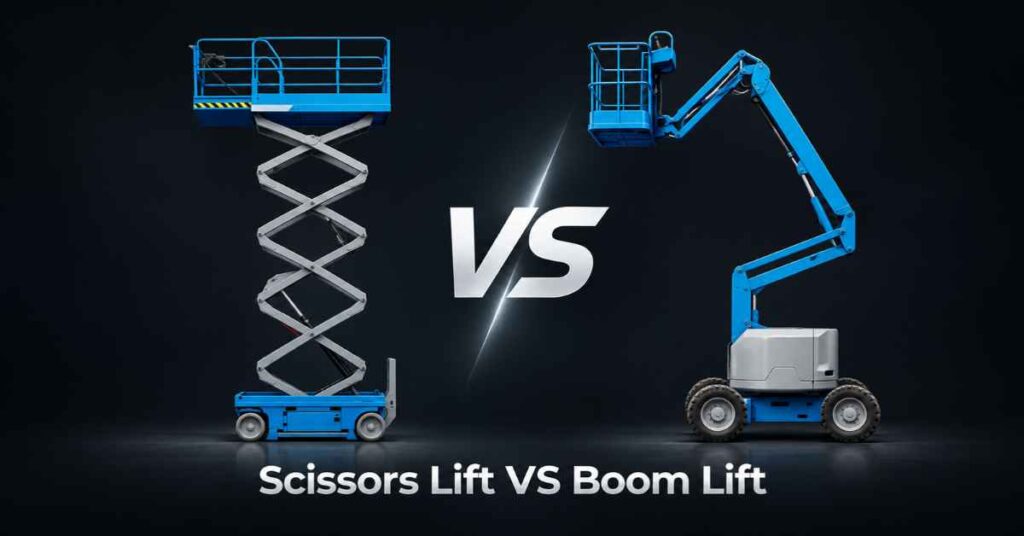
Scissor lifts and boom lifts are both aerial work platforms (AWPs), also known as mobile elevating work platforms (MEWPs). They are widely used in Malaysia for maintenance, installation and construction work at height, but serve different purposes.
In short: Choose a scissor lift for vertical access, a spacious platform and work on firm, level ground. Choose a boom lift when you need to reach over obstacles or access areas from the side. For uneven outdoor sites, select a model designed for rough terrain.
The right choice depends on working height, site conditions, platform capacity and budget. Here’s how the two compare, whether you’re buying or renting.
What Is a Scissor Lift?
A scissor lift raises workers, tools and materials vertically using a platform supported by folding, crisscross mechanisms. Unlike a boom lift, it has no horizontal reach.
Its main advantage is a spacious platform that can accommodate more workers, tools and materials. Most scissor lifts offer approximately 6–18 metres of working height, depending on the model.
Compact electric models are suitable for indoor spaces such as warehouses and factories, while rough-terrain models are designed for outdoor applications.
Working Height vs Platform Height
Equipment specifications often list two measurements:
- Platform height: The maximum height reached by the platform floor.
- Working height: The platform height plus approximately 2 metres for the operator’s reach.
For example, a scissor lift with a 12 m working height typically has a platform height of around 10 m.
Tip: When comparing equipment, check both the working height and rated load capacity, including workers, tools and materials. Some models have reduced load limits when the extension deck is in use. Always refer to the manufacturer’s specifications.
What Is a Boom Lift?
A boom lift uses an extendable arm to position workers at elevated or hard-to-reach areas. Unlike a scissor lift, it offers both vertical and horizontal reach, making it suitable for working around obstacles.
There are two main types:
- Telescopic Boom Lift: Features a straight, extendable arm for greater height and horizontal reach.
- Articulating Boom Lift: Uses jointed sections to reach over or around obstacles such as pipes, machinery and roof edges.
Boom lifts generally offer working heights from around 10 metres to over 40 metres, depending on the model. Their platforms are typically smaller than those of scissor lifts, often accommodating one or two workers with tools.
Other specialised options include spider lifts for restricted access and trailer-mounted boom lifts for applications requiring towable equipment. For lower-height indoor work, vertical mast lifts may also be suitable.
Scissor Lift vs Boom Lift: Side-by-Side Comparison
| Factor | Scissor Lift | Boom Lift |
|---|---|---|
| Movement | Vertical only | Vertical and horizontal |
| Typical working height | 6-18 m | 10-40+ m |
| Horizontal reach | No | Yes |
| Platform size | Larger, accommodates more workers and materials | Smaller, typically 1–2 workers |
| Ground conditions | Firm, level surfaces; rough-terrain models available | Depends on model; rough-terrain options available |
| Space requirements | Compact models suit narrow spaces | Generally requires more clearance |
| Cost | Generally lower | Generally higher at comparable heights |
| Common applications | Warehouses, ceilings, maintenance, M&E installation | Building exteriors, signage, steel structures, obstructed areas |
When Should You Choose a Scissor Lift?
A scissor lift is generally suitable when the work area is directly above the machine and the ground is firm and level.
Common applications include:
- Warehouses: Racking installation, lighting and high-level labelling.
- Ceiling installations: Air-conditioning ducts, sprinklers, cable trays and ceiling works.
- Factories: Routine maintenance requiring workers and tools at height.
- Commercial buildings: Indoor maintenance in shopping malls, halls and showrooms.
Tip: For jobs that require vertical access and a larger working platform, scissor lifts are often a practical and cost-effective choice.
When Should You Choose a Boom Lift?
A boom lift is more suitable when workers need to reach over obstacles, access areas from the side or work at heights beyond the capability of a suitable scissor lift.
Common applications include:
- Reaching over machinery, pipes or building structures.
- External signage installation and facade maintenance.
- Steel structure installation and outdoor construction.
- High-level work requiring extended horizontal reach.
Tip: Articulating boom lifts are useful for navigating obstacles, while telescopic boom lifts are better suited to open areas requiring greater reach.
Electric or Diesel: Which Power Type Suits Your Site?
The power source is another important consideration when selecting access equipment.
Electric lifts operate quietly without exhaust emissions, making them suitable for indoor environments such as warehouses, factories and shopping malls. Many models also feature non-marking tyres to protect finished floors.
Diesel lifts are commonly used outdoors, particularly where charging facilities are limited. However, diesel power does not automatically mean a machine is suitable for rough terrain.
For uneven outdoor sites, look for models with appropriate rough-terrain features, ground clearance and gradeability ratings. Hybrid and bi-energy options are also available for certain applications.
Tip: Always check the equipment specifications against your site’s operating conditions.
Should You Buy or Rent?
The decision depends mainly on how frequently your business requires access equipment and how long it will be used.
When Renting Makes Sense
- Short-term or one-off projects.
- Occasional maintenance work.
- Projects requiring different equipment types or heights.
- Businesses looking to minimise upfront investment and storage requirements.
When Buying Makes Sense
- Frequent or ongoing work at height.
- Regular use of the same equipment type.
- Greater flexibility over equipment availability.
- Businesses with the resources to manage maintenance and storage.
Tip: Not sure which option suits your business? Renting first can help you assess the equipment before committing to a purchase.
How Much Does a Scissor Lift or Boom Lift Cost?
The cost of buying or renting depends on several factors:
- Working height and platform capacity.
- Equipment type and model.
- Electric, diesel or hybrid power.
- New or used equipment, including age and condition.
- Rental duration and delivery location.
- Additional services, where applicable.
Generally, scissor lifts are more affordable than boom lifts of comparable working heights. Longer rental periods may also offer lower daily rates.
Tip: When comparing quotations, consider the total cost, including delivery, applicable SST and any additional service charges.
Malaysian Compliance: Certificate of Fitness and Safe Use
In Malaysia, power-driven lifting machinery may require a valid Certificate of Fitness (CF) under the Occupational Safety and Health (Plant Requiring Certificate of Fitness) Regulations 2024.
Powered scissor lifts and boom lifts generally fall within these requirements, subject to the applicable equipment classification and exemptions. Confirm the requirements for the specific model with the Department of Occupational Safety and Health (DOSH) or a registered competent person.
Before Buying or Renting
Check the following:
- Certificate of Fitness status and inspection date.
- Equipment inspection and maintenance records.
- Availability of the manufacturer’s operating manual.
During Operation
- Conduct pre-use inspections.
- Ensure operators are properly trained and competent.
- Use appropriate fall protection in accordance with equipment requirements.
- Follow the manufacturer’s rated load, wind and slope limits.
Tip: Proper equipment selection, regular inspections and safe operating practices are essential for work at height.
Scissor Lifts and Boom Lifts from Strong-Lift Engineering
Based in Jelapang, Ipoh, Strong-Lift Engineering supplies access equipment from brands including Genie, JLG and XCMG.
Our range includes Genie and XCMG scissor lifts, as well as Genie, JLG and XCMG boom lifts.
We also offer a comprehensive range of services, including equipment sales and rental, maintenance, repairs and spare parts support.
Whether for warehouse maintenance, industrial installations or construction projects, selecting suitable equipment starts with understanding your site’s requirements.
Need Help Choosing the Right Access Equipment?
Share your required working height, site conditions and project duration with Strong-Lift Engineering. Our team can help you explore suitable scissor lift and boom lift options.
Frequently Asked Questions
1. Is a scissor lift safer than a boom lift?
Neither is inherently safer. Both require suitable ground conditions, properly maintained equipment and trained operators. Scissor lifts and boom lifts have different operational risks, so safety measures should follow the manufacturer’s requirements and site conditions.
2. Can a scissor lift be used outdoors?
Yes, provided the model is rated for outdoor use. Rough-terrain scissor lifts are designed for suitable outdoor applications, while some compact electric models have restrictions on ground conditions and wind exposure.
3. What’s the difference between a telescopic and an articulating boom lift?
A telescopic boom lift extends in a straight line for greater height and horizontal reach. An articulating boom lift uses jointed sections to reach over or around obstacles. The right choice depends on access conditions and working requirements.
4. How high can a scissor lift go?
Most common scissor lifts provide approximately 6–18 metres of working height, depending on the model. For greater heights or horizontal reach, a suitable boom lift may be required.
5. Which is better for warehouse work, a scissor lift or a boom lift?
A scissor lift is generally better for warehouse tasks such as racking installation, lighting and ceiling maintenance on firm, level floors. A boom lift may be more suitable when obstacles prevent direct vertical access.
6. What about spider lifts and telehandlers?
Spider lifts are compact boom-type platforms designed for restricted access and certain specialised ground conditions. Telehandlers are primarily used for lifting and moving materials, rather than personnel, unless appropriately configured and approved.
7. Do operators need training to use a scissor lift or boom lift in Malaysia?
Yes. Employers must ensure operators receive appropriate training and are competent to operate the equipment safely, in accordance with applicable workplace safety requirements.